
Published: January 08, 2026 | Updated: January 08, 2026
Read time: 8 minutes
- While many companies experiment, few take the critical step of weaving it into their organizational culture — an imperative in today’s era of massive change.
- Making experimentation a core value helps teams learn from every test and transform ideas into measurable progress.
- Insights from Mastercard experts highlight that a Center of Excellence, reinforced by sustained commitment, can be a catalyst for cultural change.
Although it may be invisible to everyday consumers, industry-leading companies are constantly running small-scale experiments in the real world to evaluate improvements in everything from advertising and promotions to products and store layouts. But many firms struggle to establish a robust testing program because they skip an essential step: embedding a culture of experimentation throughout the organization. Without this cultural foundation, even the most advanced tools and strategies can’t deliver their full potential.
What is a culture of experimentation?
When companies embed test-and-learn experimentation into their culture, testing is not only accepted but expected, and teams are empowered to challenge assumptions, learn from tests that come up short, and make confident decisions.
“High performing brands are setting themselves apart by acting on insights from experiments, and a shared test-and-learn approach fuels that momentum,” says John Rhoades, Senior Principal and Vice President of Mastercard’s global Test & Learn Institutionalization Practice. “A culture of experimentation empowers teams to test bold ideas—even those that may not break even—while providing the tools and insights needed to make smart, data-driven decisions.”
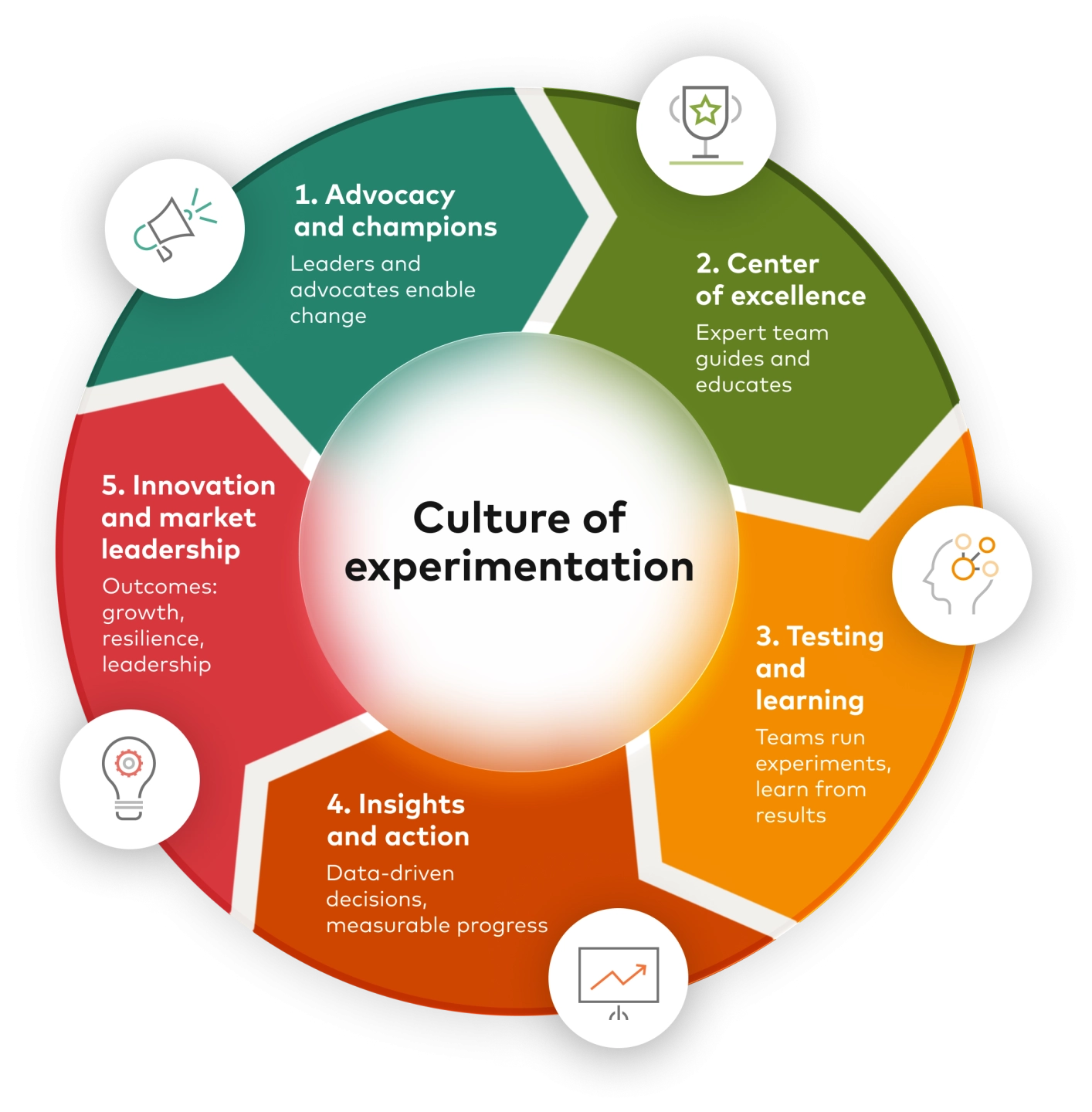
How smart advocacy can enable strategic experimentation
Modern digital tools make testing more accessible than ever, but technology alone doesn’t create an experimentation culture. The most successful programs start by fostering a mindset of curiosity and learning — then leverage tools to scale and accelerate that approach.
“Effective testing starts with advocacy,” Rhoades says. “We've seen organizations with advanced processes that can’t make changes stick, because they don't have the champions they need.”
Even firms with tight budgets achieve substantial impacts from testing when the workforce — from the C-suite down — believes in the process. Leaders can build that buy-in across the organization by appointing a passionate advocate to oversee the testing program and enlisting champions within different business units to engage their teams in the process.
“A broad network of champions ensures that the core testing team won’t be siloed off on their own, unable to communicate effectively to the departments that need their help,” says David Stringfellow, Director of Client Training and Education for Mastercard’s testing platform.
A Center of Excellence to lead cultural change
To institutionalize the culture of experimentation, businesses should assemble a Center of Excellence (CoE): a team of testing experts that will establish a clear vision for and steer the program. Serving as a nerve center, the CoE engages stakeholders, coordinates operational and data teams and may co-present ensuring that experimentation shapes strategy across the enterprise.
"The CoE is the engine of the testing culture,” says Naresh Kumar, Senior Managing Consultant for Mastercard’s Test & Learn team, who helps clients implement testing programs. “They have links throughout the business, so they can communicate with everyone involved in decision-making.”
As teams generate ideas to test, the CoE shares its expertise by developing best practices, verifying that tests align with company goals, applying statistical rigor to experiment design, and helping interpret results to guide business decisions. After teams roll out changes, the CoE tracks the outcomes and maintains a library of learnings so that the organization builds on past insights rather than repeating old experiments.
What are the keys to creating a culture of experimentation? Consistency and commitment
Building a culture of experimentation is an ongoing journey rooted in consistency and commitment. Kumar has seen how external factors, like economic shifts or organizational changes, can slow progress. For example, when a company reorganizes, it may lose internal advocates who have guided ideas from testing through implementation. In those cases, rebuilding expertise takes time—but with steady focus, firms can regain momentum and continue advancing their testing capabilities.
“Educating a new VP on the value of testing is a yearlong process,” he says.
However, a strong culture backed by robust processes and a track record of delivering value can ensure that even a major business disruption doesn’t sideline a testing program for long.
“When the culture of experimentation is embedded throughout the organization, curiosity and creativity become an entrenched part of every key decision,” Rhoades says. “You are constantly asking yourself, what can I learn next? I'm going to try some unconventional ideas, and whether they work, the lessons will drive innovation, which is priceless in today’s economy.”
Why is building a culture of experimentation worth the investment?
Organizations get the most out of testing by treating it as a catalyst for innovation — but that often requires the CoE to reshape objectives and redefine success. To uncover meaningful insights, companies should prioritize initiatives using multiple filtering criteria: economic potential, strategic alignment, feasibility, ability to drive a clear decision, and an ideal balance between uncertainty and the range of possible outcomes. This approach ensures that tests are not just “safe bets” but are positioned to deliver actionable learning and long-term impact.
“When experimentation becomes part of the fabric of the company’s culture, our clients move away from testing incremental tweaks that generate a bit of extra revenue,” Rhoades says. “The goal is to explore big, bold ideas that we can really learn from.”
To maximize impact, businesses must also embrace when a test comes up short the way scientists do. Determining why an idea performed the way it did — and how to refine it — is more important than the outcome itself. Sometimes experiments do not break even and only succeed with a fraction of customers. However, instead of dismissing these efforts, leaders should capitalize on the new data to develop innovative strategies and refine customer personas. For instance, experiments can reveal a negative impact while still uncovering valuable learnings for continued innovation and growth.
"If a business leader only runs tests they know will turn out positive, not only is the organization not learning, but the test is unnecessarily delaying known value," Rhoades says. "Only when this business leader stops worrying that their idea will not work can they start pushing the envelope."
Rhoades also recommends that before testing begins, leaders agree on the specific performance thresholds that will prompt a wider launch. “If they all sign off ahead of time on what it's going to take to say yes, there’s no hesitancy when the results come in,” he says.
Expert spotlight: The voices behind the insights
John Rhoades – Senior Principal and Vice President of Mastercard’s global Test & Learn Institutionalization Practice
John Rhoades has led the Global Client Training and Education team for 12 years at Mastercard. He has helped hundreds of organizations worldwide build sustainable Test & Learn cultures and partners with C-suite leaders to drive innovation and measurable value. Previously, John spent 11 years at Petco, where he built a vibrant experimentation program averaging 75–100 tests annually, and began his career as a process improvement consultant at Cap Gemini Ernst & Young.
Naresh Kumar – Mastercard Global Client Training and Education
Naresh has spent 13 years at Mastercard focused on Test & Learn, where he co-leads Global Client Training and Education. He has assessed testing readiness for 150+ organizations and partnered with clients to build Centers of Excellence that scale experimentation programs. Naresh also hosts executive conferences on emerging topics like Open Banking, Cybersecurity, and Alternative Payments, and brings deep expertise across 45+ Mastercard products.
David Stringfellow – Mastercard Global Client Training and Education
David has spent 10 years at Mastercard leading client training and education for Test & Learn. He has developed comprehensive eLearning and live programs, hosted hundreds of sessions, and partnered with clients to embed best practices for maximizing testing value. Previously, as a Managing Consultant, he helped organizations build sustainable data-driven cultures—designing and analyzing tests across merchandising, marketing, capital expenditures, operations, and pricing.
Interested in learning more?
In today’s era of massive change, a culture of experimentation is essential for staying ahead. Organizations that embrace Centers of Excellence, strong advocacy and test-and-learn approaches create an environment where innovation thrives and decisions are grounded in evidence rather than assumptions.
Mastercard Test & Learn® enables businesses to experiment in real-world conditions, measure impact with precision and transform insights into confident, performance-driven actions. Whether you’re refining your approach, responding to emerging opportunities or driving breakthrough ideas, Mastercard helps you move from strategy and planning to execution and optimization. Discover how we support the full growth journey.